Climate change - can you feel it?

November

Yes Sir, Captain Tightpants
Joined
Jan 20, 2008
Messages
13,184
Location
Australia
Sineya
Do you notice anything where you live?

I notice the dry. The mositure gets sucked out of everything on dry day. The soil is dust and the air is thick with it. There feels to be more electricity in the air during thunderstoms. Rain either flecks and evapourates fast, or comes down hard, floods, washes the dust away and is gone in mere minutes.

Inland living is wildly different to coastal living, and not something I took into consideration when moving here. Some say the weather has not cycled out of its usual (for the last century) cycle. Others say, the change is dramatic from years gone. My town has been identified as very high risk of being wiped out by climate disaster.

The swings in temperature are difficult to deal with. At night, it could drop to frosts while daytime temps reach the 30's. I feel I am fighing a losing battle by trying to grow food in the dirt. The farmers have had a great season here, with lots of feed put away for the predicted drought times ahead.

Facing the weather in a place like this reminds me how tiny and insignificant a single humans actions are. None of us are on the same page about it, none of us have a hope of changing what is to come. How do you see your environment changing?
 
DeepBlueJoy
DeepBlueJoy
Great topic. Thank you for provoking thought!
It is heading back to where it was a thousand years ago. Some scientists say we cannot be sure about what happened then because the thermometer was not in use at the time but when the Vikings settled Greenland, they grew crops of rye and set up a culture much like that in Norway at the time. You can't grow rye there now, it's too cold but recently they have been starting experimental crops in Greenland selected for a short growing season. When the cold came, they could have followed what the natives were doing and adapted but they did not and thus died out by about 1300 AD.

In the mediaeval "little ice age", the concentration of carbon dioxide in the air was as low as 285 ppm and leaves preserved from that time show huge quantities of stomata, the breathing holes in leaves, to compensate for the stress of low CO2 concentration. We are at about 410 ppm now which is adequate. People have postulated that 350 ppm would keep temperatures steady but there is no real need for it. In the era of the dinosaurs, the CO2 was at 1100 ppm and the lush vegetation kept oxygen levels in the air at 30%. Large animals like dinosaurs could not exist at lower concentrations. However, this made forest fires a major issue.

Going back in history, there was a time of "snowball earth" where open water only existed in a small band around the equator. Volcanic eruptions brought out huge quantities of greenhouse gases that brought the CO2 concentration to 7000 ppm. This caused a steady meltback and additional vegetation absorbed a lot of the excess CO2.

The problem is not so much that the climate is changing but that we have put concentrations of people in areas where there is insufficient water. California now has a greater population than Canada and owes a lot to Canada - the surveyors and civil engineers who designed and installed the aqueduct system in California were from the province of Ontario, which is why there is a city called Ontario CA. South Africa is going to be the first place where established cities like Capetown and Durban are going to become uninhabitable within a decade due to water shortages.
 
The small trees in my yard are dying, even though I water them every other day. There's only dry dirt where the lawn used to be. Eight years ago, my yard looked like Eden. Hummingbirds hung out, and flowers grew. Now it looks like somebody nuked it.

The sun is getting hotter. That's what's causing this climate change.
 
ILLYRIAN
ILLYRIAN
The sun isn't getting hotter but it is getting closer to earth.
Yeah the lack of water is such an issue. The farmers here base their predictions on South African conditions. Australia has water restrictions in place regularly. We have desal, waste recycle and catchment areas. None keep up with the population growth. Townsville is on the brink of dry disaster.

It is so weird for me, to have this rocking summer tan, but needing to hide it with layers of clothing in late spring! It is barely over 10C here today, but the ground is still warm from our heat last week. The dark sand holds the heat and encourages evapouration. The sun does feel hotter. First it sucks you dry, and then it burns ya to a crisp.

Its so odd today, for it to be this cold and sprinkling, yet so, so dry. At nights the temp drops SO fast, it is like a scene from a disaster movie with impending ice death approaching.

The plants are important, they need to survive. The more life in a place, the more a place can support life. The government puts pressure on communities to lower their water usage, when really they need to be looking into long term solutions to cope with the expanding populations instead of further restricting existing populations basic water rights. Mining has contaminated vast areas of fresh water. But rocks make more money I guess.

Scene from africa are frightening. The dutchies I used to live with thought nothing of leaving taps running or leaking, they could not believe how fast the horses water troughs dried out, they never realised how precious water is. There was too much of it where they came from.

There are better ways to manage water on individual properties, but I find, in a farming community, it is hard to crack into their thick skulls with new ideas. My place is a brown oasis right now. They see hay/mulch as a fire risk, I see less loose dust and more structure to hold moisture in. I am so easily swayed by the opinions of others. Especially from elders.

Can we trust any of the scientific predictions? Who is working towards a secure water future? Should we be changing/shaping the structure of modern society in a safer way? Are there any countries that are going to be benefiting or that are well prepared to cope?
 
There was a time when the future of mankind was planned we let machines do the work and mankind can rest. Unfortunately though the dumb politicians and several dumb religions allowed a vast increase of population to bugger up the plans.
Those religions and the politicians have ensured that Gods Creations are all but dead.
I give mankind until the turn of the century, hopefully mankind will die out so that Gods other creations can live, and that includes the planet.
Is it getting hotter and drier? It is starting to, the use by date is in the past and will get worse it we don't change.
So who's for a beer?

When was the last of Gods miracles seen? Or is it as I believe that God hates mankind, after all they did murder Gods son.
 
Last edited:
Water levels are sinking, the Canal where I live (an old Viking route) has sunk a frightening amount. In Stockholm some old houses are sinking because of it.
This incredibly hot summer caused a draught with harmful effects for farmers and forest fires. Never seen a summer like it, it was depressing.
Unseasonably warm falls and later winters. Snow fall occurs later and less now where I live.
 
Skanky Vamp
Skanky Vamp
To be honest, that whole snowfall thing could go either way; good or bad.
Much longer and hotter summers where I live (upstate New York). Occasional winter days where the temperature is 40-50 degrees above normal. Maybe five years ago there was a year where Central Park in NYC had the same temperature on Christmas Eve as on the Fourth of July.

We just had a big snowstorm here and the temperature is supposed to go down to around 0 on Thursday night. But we could just as easily be wearing shorts at Christmas.
 
I've been talking about the weather with @PassionBecoming and for her she's currently at -15f which is more January weather, she's in Minnesota and I visited at this time of year a few years back and it was not even below freezing then, but this year they had snow at the start of October.
 
Where I am (DELMARVA) the weather has become even more unpredictable. Warm winter. Cool wet summer. Not much of a fall -- I can't remember the last time i saw lovely 'fall color' -- we have weather snaps and snap backs... One day it's 80, next it's 40, then we have a quick freeze and it is back into the 50s and summer's over. No time for leaves to turn. You got green, then you got brown and leaf drop.

What is true is that we have too much heat in the system and that means we will have more and more EXTREME weather. People think it means you'll get heat, but that's not how weather works. More energy means more churn... so you'll get fires, you'll get bigger, nastier storms -- and even occasionally bigger nastier snow storms... b/c way up in the sky where currents cause change, there's heat. Not all the air that ends up at ground level will be hot though... at least, not at first. And we only have to look to the huge fires to see part of it in action. Fire. Flood. Drought.

I do my best to not add to the mess by driving a low emissions car most of the time, but of course, we have two cars, so maybe not the absolute best. We're killing the planet and the most vulnerable people in the world have the least control over what happens, and that includes the young. They will bear the worst of it. We are now suffering in small pockets. In time to come, the suffering will become less and less avoidable for everyone.

We won't be able to throw money at the problem when there's no drinkable water or breathable air and the waters start rising too far and too fast to allow escape.

Sadly, we are taxing the planet beyond its ability to compensate. Oh, it will recover... but it could take thousands of years. The planet is actually pretty sturdy... until you start blowing things up. The developments of the last 200 plus years are orders of magnitude bigger than all of previous history. The planet cannot absorb it as fast as we are throwing it. And LIFE cannot handle that kind of change.
 
Last edited:
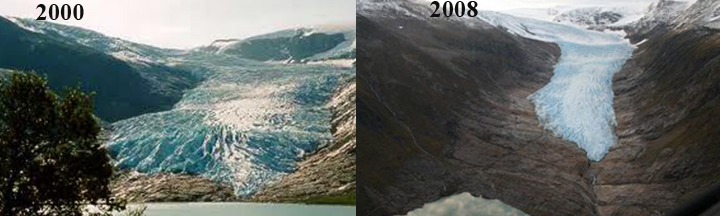
engabreen-2000-2008.jpg

I climbed this glacier as a wee lad with several pairs of woolly socks on to help me fit my climbing boots. It's really sad. In 2015 alone, it withdrew 56 meters/183 feet (sic!).

Then again, I hate the cold part of the year.
 
Last edited by a moderator:
DeepBlueJoy
DeepBlueJoy
Picture. More than a thousand words. That is so depressing. Thanks for sharing.
I keep wondering with all the hydrocarbon fuel we burn, where is the "hydro" part of the hydrocarbon going? For each molecule of octane burned, we get eight molecules of CO2 and nine molecules of H2O. I would have thought we would be awash in excess water, not facing drought.

I don't get too concerned about CO2 because it has an automatically declining effect. The normal temperatures generate infrared in the 8 (hot) to 14 (cold) nanometer range. CO2 operates as a greenhouse gas at wavelengths longer than 10 nanometres so as the temperatures rise, it has less effect. We would have less CO2 if in addition to not burning fuels with carbon in them, we stopped cutting down forest that take CO2 out of the air and stopped covering oceans with oil that prevents the single-celled plants from doing the same.

What does scare me is something that has not been discussed in most environmental studies - the fact that the earth's magnetic field is declining and moving to the northwest at a rate of 24 miles / 40 km each year. It used to be said that all compasses point to Canada but the north magnetic pole has cleared the Canadian arctic islands and will be closer to Russian territory in 50 years. The earth may be getting hotter because the liquid core is getting closer to the surface. No one pays attention to this because you can't monetize it. You can convince people they are wrong for burning fossil fuels and initiate carbon taxes and cap-and-trade deals to suck more money out of people's pockets but you can't convince anyone that they have anything to do with polar shift. The El Nino and La Nina years are known to be caused by undersea volcanoes east of the Philippines. The pressure at the 4400 foot below sea level altitude of these volcanoes is enough to keep the water in liquid form. As the heated water rises, it delivers its heat to the surrounding water without any steam bubbles being formed but the surface of the Pacific east of there is about 2°C warmer with the volcanoes active than dormant.

We are overdue for a switchover of the north and south magnetic poles. The fossil record shows this has happened many times before. As lava cools, it retains the magnetic field direction that it had when it passed below the Curie point (the temperature above which molecular motion overcomes permanent magnetism). At the times and locations where the switchover happens, the fossil record shows strange plant mutations due to cosmic rays hitting them. The magnetism of the earth has declined 10% since 1854 when the first measurements were made. There may be some experimental error, but not that much.
 
We're in the nice stage in the UK. We've just had a lovely long summer, it was awesome. Awesome as it was it's obviously not worth cooking the planet for.
 
We're in the nice stage in the UK. We've just had a lovely long summer, it was awesome. Awesome as it was it's obviously not worth cooking the planet for.

Except for the farmers that after the cold winter we had, the late snow then the heat found it hard to get crops to meet demand.
 
The Bronze
The Bronze
Yeah I meant awesome for me. Festivals, beach trips and bbqs. Definitely not good all round.
Taake, how could you be so kind to me thanks, #7.
But what you said gave me the giggle fits.
@Taake, water levels are sinking.
I fought hard not to laugh, imagine that the water is sinking, how does water sink and it what.

the canal where I live (an old Viking route) has sunk a frightening amount. Once again we have a canal that has sunk
 
Taake, how could you be so kind to me thanks, #7.
But what you said gave me the giggle fits.
@Taake, water levels are sinking.
I fought hard not to laugh, imagine that the water is sinking, how does water sink and it what.

the canal where I live (an old Viking route) has sunk a frightening amount. Once again we have a canal that has sunk

Guess I don't see the humor in this.
 
ILLYRIAN
ILLYRIAN
That might explain why the drabble I found hilarious, about Dana calling Spike handy fell of deaf ears. In the episode of Angel she cut off Spikes hands.
Are any cities starting to prepare for the issues in your countries?

I vaguely remember hearing Venice uses pumps, and places that regularly flood are being re-accessed. What countries are going to cash in on the water shortages near the equator?

Are you noticing any extinction events or new species?
 
HoppyHippy,
the stinking rich guys in Saudi Arabia are trying to get a Jesus type guy to change the oil into water.
Is that the sort of thing you mean?
 
Are there any South African posters on the board? I heard earlier this year that Cape Town was on the verge of running out of water, it was being rationed and the rations were having to be cut ... but within a few weeks there would just be none left. I think it got sorted in the end (the rain must have come) because they didn't end up having to abandon the city - but it was pretty scary stuff, they would have been the first city in a century to run out of water.

The weather was mad this last year in Britain - deep snow in March, and then glorious hot weather by May day. There was very little actual 'Spring' - anything that was growing before the snow was killed off and then it got suddenly much hotter than normal and it was like the trees and plants weren't sure what to do. The foliage looked like it was mid July when it was only early May. And by July it was brown and dry.
I can't speak for the whole island - but in the North of England it hasn't really got cold even yet (it's much colder than it was - but it's certainly not freezing). And there doesn't seem to be much rain.

But then, ten years ago it poured it down pretty much every day from July- December. Loads of people were flooded out of their homes - and nowadays you wouldn't buy a house without checking that it wasn't on a floodbank first. Hardly anyone would have thought to ask that before 2008 - floods just didn't happen. Now, somewhere will flood most years.

So - whatever climate change brings to Britain - it isn't going to be consistent. Which only makes it harder for farmers and councils to prepare for the weather conditions and mitigate the effects.
 
nightshade
nightshade
Wet, miserable and hasn't gone above 5c in a few days. It's cold down south!
Back
Top Bottom