Impartiality... Does it Exist?

Cohen

Hellhound
Joined
Oct 24, 2005
Messages
4,295
Location
Neptune, California
Sineya
So the Mock Trial proposal got my mind spinning, and I didn’t want to bog that thread with hypotheticals and philosophy. Therefore I decided to start this thread to talk about the idea of Impartiality.


Plus...I have problems with the idea of impartiality. I'd be no use to you whatsoever.
@TriBel I am very intrigued by your statement, and want to hear more.

And any others... I’m just posing the question and let’s go from here.

Can one be truly impartial? Why or why not?
 
I think true impartiality doesn't really exist but thats don't have to impact the game if everyone decides to put aside their personal preferences and just only the arguments presented in the trial, as if this were a real court. Example: I dislike Dawn but if she were on trial I'd put aside personal feelings about her.
 
While psychological studies have a lot of flaws in them (in part because of their own biases that ignore a lot that don't confirm them) the brain itself apparently sabotages its own interpretation when it comes to identity, be it political, religious, or even just shipping. Sometimes it's deliberate and self-aware, but I think more often than not it's just what one looks for stands out while something that isn't of interest or relevance easily gets overlooked, which creates a warped picture (and the deliberate creation of buzz words, of which I'll give no examples on the left or the right, also promote a false narrative in the minds who keep hearing them, even if they don't use the buzz words themselves). And once a strong interpretation, or even fan theory, gets set in a person's mind, it's even harder to see outside of one's tunnel vision.

Having the lore seem to change even be turned upside down at times certainly didn't help.

Even little things can do it. I don't want to use an extreme example (though I so very easily could), so I'll go with something simple. In one thread I mentioned Buffy might have a stint of alcoholism. While I think those who protested did so a bit much, I realized I made my own jump based on too little. But it's understandable because my own mother was an alcoholic and I was, subconsciously, projecting my own life experiences onto the screen, and I hadn't even realized it.

I understand many law enforcers get really frustrated with witnesses because not even the description of a criminal remains consistent, and can vary by a lot. An interesting one I heard of was that one kid said he saw a black and white boy running off from a store owner as together, while his openly racist father saw the white boy as attempting to help the white store owner, because that's just how their brains interpreted the world (the boy saw it as kids vs adults while the adult racist saw it as black vs white). Neither ever found out which one had interpreted the scene right.

Lawyers also screen jurors carefully for signs of their worldview that could color their perception of a trial.

It's also why the system tries to isolate jurors from society, especially if it's about something on the news. They don't want them to form opinions based on conjecture and/or with their own "tribes."

It's also part of why I've been hesitant to play this game and have barely glanced at it. But I might.
 
Probably not. In a lot of ways we're all probably not watching the same show which is isolating but also really cool because there's millions of versions of Buffy and millions of versions of everything we see.

I think we're all alone with our own versions of reality and life is just us all trying to negotiate a shared reality together.
 
Like, can you render a fair decision based on the facts and circumstances of a case without fear or favor to either side? Yes. Sure, there will always be marginal cases in which the truth of the matter is hard to obtain, but for the bulk of decisions, yes, entirely possible.
 
I was in a jury pool in June of 2019 and the case had been so grisly and sensational that there was a pool of 120 jurors in six groups of 20 people. The only questions allowed in jury selection were, "Did you read or know anything about this case before you were selected for the jury pool?" and "Could you form an impartial opinion even though the defendant is Chinese?" There were no meandering questions allowed because there wasn't time for it. Once you were stood up before the prosecutor and the defense counsel, they would say "accept" or "challenge" and if either one said challenge, you were out. I was 15th in the second cohort of 20 people and by the time I got there, they had only selected two jurors. The defense counsel said "challenge", so I was out. They needed 14 jurors (12 to sit and two spares in case someone was indisposed). BTW saying you had read the news or that you were biased against Chinese did not get you out of jury service. They seemed to be looking more for a poker player's tell than the actual answer.

The case was for a murder that had occurred in 2012 where a Chinese girl in Toronto was talking to her boyfriend in China on Skype when her Toronto boyfriend came home unexpectedly. He took a knife and stabbed her to death while she was on Skype as her China boyfriend watched. The boyfriend in China called the Metropolitan Toronto Police and told them what he had seen and by the time the police got there, she was nowhere to be seen but there was a massive bloodstain on the carpet. Over the course of the next few weeks, her legs, arms, torso and head were found in dumpsters all over the city.

Do I think anyone was impartial? No. Would the jury get it right anyway? Probably.
 
I'll add that, while I really don't believe there is such a thing as true impartiality (like true objectivity, which is the word favored by most philosophers) at the same time I think nevertheless there is value in the attempt to be as impartial as one can anyway in some circumstances. The attempt to be impartial can in some situations be proof of one's intellectual integrity, and should be valued, despite the fact impartiality or objectivity in the absolute sense really isn't possible. I'll leave it at that.
 
Last edited:
What has impartiality got to do with the example Ethan Reigns wrote of (#8), you might think it is your ability to think the best of the Chinese people or the Canadian people.
What we are faced with, is do you believe what the Chinese boyfriend said, or do you believe what the Canadian guy will say.
Do you really believe that a lack of impartiality would make you think the Chinese guy is lying?
I don't think that impartiality has anything to do with it.
 
Ethan Reigns
Ethan Reigns
Both of her boyfriends were Chinese.
Can one be truly impartial? Why or why not?

Firstly this is a great idea for a thread. Objectivity, truth, bias, these are all interesting things to discuss.

I'm going to fudge it and say 'to a degree' yes we can be impartial. We can give it a good try. To go about it you need to ascertain a metric or set of standards and hold everything to that same set.
Let's take art as an example, and since this is a Buffy board we'll zoom in on the seven seasons of Buffy:
If you wanted to try and 'impartially' declare which season is say, the best written (or has the best character arc or the most well-realized themes, etc) then you'd attempt to nail down what we mean by 'best written' and then be consistent in that.

And I'm not saying that by doing this someone is making their opinion 'better', just that they are getting a clearer understanding of their own reasoning, thought processes and personal tastes.
We all sometimes inexplicably like an episode that most people don't, we call it a guilty pleasure and reason that that's all there is to it. Conversely we can take against a 'fan favorite' and declare it over-rated and move on.
By trying to exact a set of standards and attempt to be objective we can get to discover why we like a thing, a trope, a character, a season and getting to the why is always useful. It's not about 'owning your bias' (which is a useless and intellectually dishonest turn of phrase) but putting bias to one side and looking at something critically. I agree with @Give Us A Kiss in that I don't think anybody can do this successfully 100% of the time, but its the process that's useful.


And also as everyone is bias to a degree I often find it interesting when one person accuses another of bias. I never find it useful because it doesn't really address the core of any argumentation.
For example if I broke down why the latest crop of DC films are terrible because of their poor understanding of character and source material, their cynical nature and all the moral issues raised that are blatantly ignored...and then somebody says that I'm bias Marvel/Disney shill then that doesn't address any of the issues that I've raised.
Therefore there's no real substantive discussion to be had. It's kind of boring and frustrating, there's little point in debating with an immature personality.

So, yes we are all bias but we can strive not to be, and its that process that is useful for how somebody can look at history, analyze politics or bingeing their favorite Buffy season. Find out why.
 
I suppose it is impossible for human beings to ever be completely without bias, but I know a criminal defense lawyer who thinks having a jury is far better than trial by judge. Twelve people may counteract each other's biases, at least.
 
Impartiality in a criminal court, very doubtful that might exist.
The courts are supposedly a place where the truth is found, that a magistrate, judge, whatever, are supposedly a person who has a religious bent on telling the truth - rubbish.
The court is said to have religious conotations - rubbish.
The lawyer, solicitor, barrister for the guilty party is allowed to lie, that isn't very religious is it?
The lawyer, solicitor, barrister for the innocent party is allowed to lie, that isn't very religious is it?
The only person who has to tell the truth (but often lies) is the person who swears on the bible he will tell the truth yet they know that those asking him/ her questions can lie as much as they want.

The courts seem to be against the truth.
 
I am amused by the practice of having someone swear on the Bible in a court of law. The Bible says:

Mt 5:37 Simply let your "Yes" be "Yes" and your "No" no; anything beyond this comes from the evil one.

Jas 5:12 Above all, my brothers, do not swear - not by heaven or by earth or by anything else. Let your "Yes" be yes and your "No", no or you will be condemned.
 
I suppose it is impossible for human beings to ever be completely without bias, but I know a criminal defense lawyer who thinks having a jury is far better than trial by judge. Twelve people may counteract each other's biases, at least.
This is interesting though. Because in tv juries are almost always depicted as “let’s get this over with” and “we already know he’s guilty”. I’ve never served as a criminal trial juror, so I have no experience there. But is this generally the case? Or just Hollywood hoopla?
 
T
thrasherpix
It really depends, and the two lawyers fight hard on whose to be allowed on the jury. There are enough juror (and judge) horror stories that I'd be willing to put my fate in a spinner pointing to random verdicts & punishments
I've never served on a jury, either, but I did do jury duty once, going through three 'voir dires', and I felt like people took it very seriously. I think people understood that they were being given power over someone's life. Of course, there were a few who wanted to be dismissed from service, and they were, because the lawyers don't want someone like that on the jury.

A good movie about juror bias is "Twelve Angry Men." Hollywood hoopla perhaps, but it does a great job showing how biases affect judgment.
 
Re: Jesus; Well, while some Christians do refuse to take oaths in court at all, only affirming that what they say is the truth, others see no problem in swearing an oath, when it is demanded by civil authority. What Jesus was speaking of, was more akin to false contracts, where you agree to something while you were already plotting to find a loophole to get out of it. That was a corrupt practice of an increasingly legalistic Judaism of his day. The purpose of oaths in the first place was to affirm you were telling the truth, not to provide cover for lying. Just tell the truth, oath taking holds no terrors for honest men.
 
There is no such animal. Fairness, yes, but impartiality is impossible.

This is why computers (for example, image handling that sees non-white faces as criminal) get it wrong when asked to make jugements. They are a) programmed in prejudice of programmers b) lack human ability to make assessment - so impartially 'choose' wrong - because they cannot organically judge.

So, I prefer fair judgment by open minded than some fake "impartiality" that doesnt truly exist in people or machines.

I am amused by the practice of having someone swear on the Bible in a court of law. The Bible says:

Mt 5:37 Simply let your "Yes" be "Yes" and your "No" no; anything beyond this comes from the evil one.

Jas 5:12 Above all, my brothers, do not swear - not by heaven or by earth or by anything else. Let your "Yes" be yes and your "No", no or you will be condemned.
I don't swear on anything either. It is ironic that people swear on a book that exhorts us not to!
 
This is why computers (for example, image handling that sees non-white faces as criminal) get it wrong when asked to make jugements. They are a) programmed in prejudice of programmers b) lack human ability to make assessment - so impartially 'choose' wrong - because they cannot organically judge

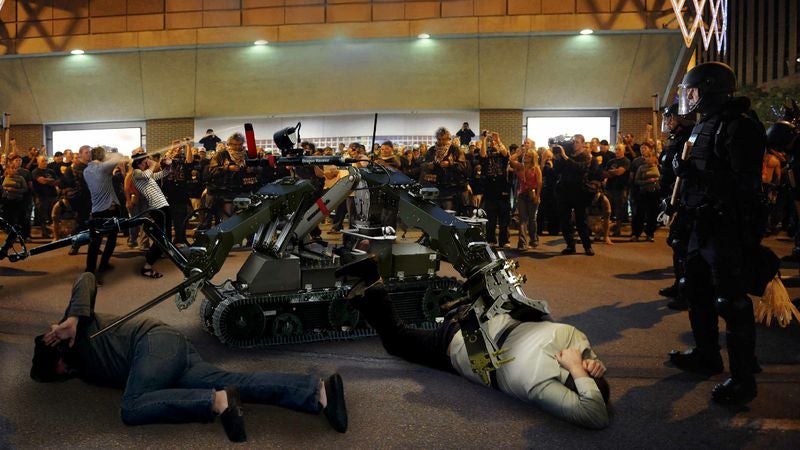
Laugh or cry as you choose from this satirical news site (one that has complained in the past that it's so hard to compete with the reality):


The particular part that I thought of as I read your post:

Sources say the AP-12 represents a vast improvement over previous incarnations of the law enforcement robot, pointing to the inherent deficiencies in such models as the AP-5, released in 1999, which was disastrously unable to distinguish between whites and non-whites
 
Back
Top Bottom