

Over a quarter of Americans have made malicious online comments
by Anne Gammon
A “troll”, in internet terminology, is someone who is deliberately provocative, upsetting others by starting arguments or posting inflammatory messages on online comment sections. Trolling is a problem that is gaining increasing attention and some websites are changing their comments processes or blocking comments altogether.
A year ago YouTube changed their moderation process to help users moderate others’ comments more easily and move more engaged discussions towards poll position.
Although only 45% of adults have heard of the term troll, 28% of Americans admitted malicious online activity directed at somebody they didn’t know.
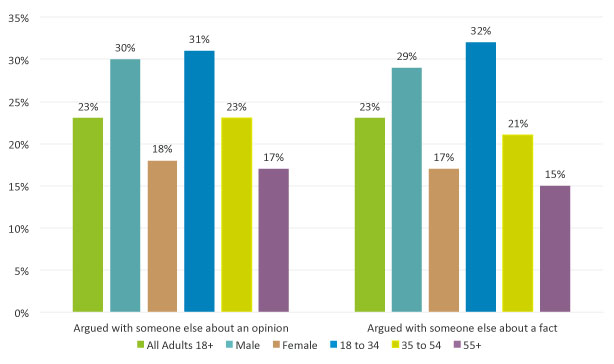
Nearly a quarter of those who have ever posted content (23%) admit to having maliciously argued over an opinion with a stranger, while 23% have maliciously argued over facts. 12% admit to making deliberately controversial statements. Men are more likely to get into a malicious argument than women and Millennials are twice as likely as those aged 55+ to engage in trolling behavior.
12% of posters admitted to having crossed the line so far that they have had their comment removed by a moderator.
Commenters who have either argued with strangers maliciously about an opinion or about a fact
Where are the trolls hiding?
The most frequently read comments sections are on social media with 60% of Americans checking out comments on their Facebook, Twitter or other social media accounts at least once a week. This is followed by video blogs like YouTube or Vimeo (36%).
The comments sections most frequently contributed to are also the social media and video sites.
However, according to those who read the comments, it is the less used chat-rooms that have the most active trolls. 45% of people who read comments in chat rooms like Reddit report seeing malicious trolling behavior once a week or more. Not far behind are social media sites (39%), and blogs (39%).
The action taken by YouTube last year may have gone some way to resolve the trolling issue as only 33% reported being aware of trolls on video sharing sites once a week or more.
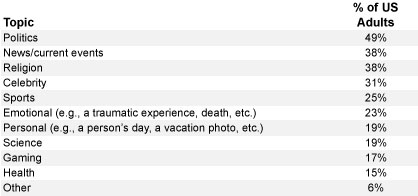
The topics most likely to set off the tolls are politics, news and current events, and religion. Nearly half of responders had seen trolling behavior around political content (49%). Gaming (17%) and Health (15%) content seems to attract least vitriol.
How often, if at all, do you see internet trolling behavior on the following types of media? All answering at least once a week.
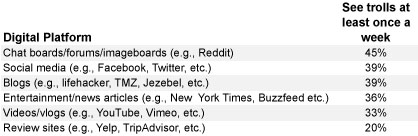
Base US adults who have ever read comments on those digital platforms
On which, if any, of the following topics have you EVER seen trolling behavior on the Internet?
Anonymity
The vast majority of Americans – more than three quarters (77%) – think people are more likely to engage in trolling behavior under cover of anonymity.
And Americans enjoy anonymity online - nearly one third of Americans (32%) have created an account for a website without having to supply their personal information. It is the preferred method of logging in to websites, with 27% preferring to create a login this way rather than using a social media login or sharing personal information. Millennials in particular prefer anonymous logins (39%).
How to spot and stop trolls
It seems that malicious intent is the key to defining trollish behavior.
46% of adults believe that the line is crossed when a commenter is clearly attempting to upset someone else, and 50% believe that it is when the commenter is attempting to upset many different people at once. 44% of adults are ready to call someone a troll if they don’t stop their behavior even after being asked to.
What is the best way to get rid of an Internet troll? 14% of adults feel that there is no efficient way to stop a troll. But there may be hope: about a quarter of adults (24%) prefer reporting trolls to a moderator, and 30% of troll victims have used this tactic. However, no response at all seems to be the winning strategy.
The defense most popular with victims of trolling, ignoring the trolls completely, is thought by many adults (37%) to be the most effective way of stopping them.
Source: YouGov.com
by Anne Gammon
A “troll”, in internet terminology, is someone who is deliberately provocative, upsetting others by starting arguments or posting inflammatory messages on online comment sections. Trolling is a problem that is gaining increasing attention and some websites are changing their comments processes or blocking comments altogether.
A year ago YouTube changed their moderation process to help users moderate others’ comments more easily and move more engaged discussions towards poll position.
Although only 45% of adults have heard of the term troll, 28% of Americans admitted malicious online activity directed at somebody they didn’t know.
Nearly a quarter of those who have ever posted content (23%) admit to having maliciously argued over an opinion with a stranger, while 23% have maliciously argued over facts. 12% admit to making deliberately controversial statements. Men are more likely to get into a malicious argument than women and Millennials are twice as likely as those aged 55+ to engage in trolling behavior.
12% of posters admitted to having crossed the line so far that they have had their comment removed by a moderator.
Commenters who have either argued with strangers maliciously about an opinion or about a fact
Where are the trolls hiding?
The most frequently read comments sections are on social media with 60% of Americans checking out comments on their Facebook, Twitter or other social media accounts at least once a week. This is followed by video blogs like YouTube or Vimeo (36%).
The comments sections most frequently contributed to are also the social media and video sites.
However, according to those who read the comments, it is the less used chat-rooms that have the most active trolls. 45% of people who read comments in chat rooms like Reddit report seeing malicious trolling behavior once a week or more. Not far behind are social media sites (39%), and blogs (39%).
The action taken by YouTube last year may have gone some way to resolve the trolling issue as only 33% reported being aware of trolls on video sharing sites once a week or more.
The topics most likely to set off the tolls are politics, news and current events, and religion. Nearly half of responders had seen trolling behavior around political content (49%). Gaming (17%) and Health (15%) content seems to attract least vitriol.
How often, if at all, do you see internet trolling behavior on the following types of media? All answering at least once a week.
Base US adults who have ever read comments on those digital platforms
On which, if any, of the following topics have you EVER seen trolling behavior on the Internet?
Anonymity
The vast majority of Americans – more than three quarters (77%) – think people are more likely to engage in trolling behavior under cover of anonymity.
And Americans enjoy anonymity online - nearly one third of Americans (32%) have created an account for a website without having to supply their personal information. It is the preferred method of logging in to websites, with 27% preferring to create a login this way rather than using a social media login or sharing personal information. Millennials in particular prefer anonymous logins (39%).
How to spot and stop trolls
It seems that malicious intent is the key to defining trollish behavior.
46% of adults believe that the line is crossed when a commenter is clearly attempting to upset someone else, and 50% believe that it is when the commenter is attempting to upset many different people at once. 44% of adults are ready to call someone a troll if they don’t stop their behavior even after being asked to.
What is the best way to get rid of an Internet troll? 14% of adults feel that there is no efficient way to stop a troll. But there may be hope: about a quarter of adults (24%) prefer reporting trolls to a moderator, and 30% of troll victims have used this tactic. However, no response at all seems to be the winning strategy.
The defense most popular with victims of trolling, ignoring the trolls completely, is thought by many adults (37%) to be the most effective way of stopping them.
Source: YouGov.com


