

Anyanka Bunny Slayer
✨ Hail Hydra ✨
- Joined
- Dec 17, 2015
- Messages
- 13,810
NASA will help Uber develop a fleet of air taxis to shorten commutes.
Uber is taking a big step towards making its vision of flying vehicles a reality, announcing on Wednesday an agreement with NASA to develop a fleet of air taxis by 2020.
The idea is to build a network of vertical takeoff and landing aircraft that would greatly reduce commutes, while also helping to ease vehicle pollution in major cities.
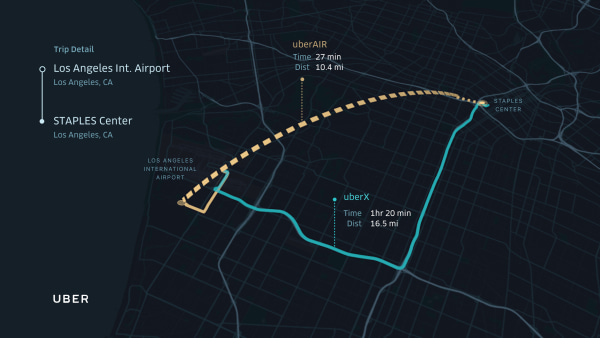
A sample trip from Los Angeles International Airport to the Staples Center in downtown Los Angeles. Courtesy Uber
While the ride-hailing service and the U.S. space agency may seem like an odd couple, the relationship is necessary in order to keep everything running smoothly when Uber ultimately takes to the skies.
"The space act that we signed with NASA is initially about collaboration around air traffic management," Jeff Holden, Uber's chief product officer, told NBC News. With so many aerial vehicles flying at a low attitude, the collaboration will be necessary to help manage the skies.
Related: Uber's Fleet of Flying Taxi Cabs
Uber also announced that Los Angeles will be the second U.S. city where it will test its uberAIR service. Dallas-Fort Worth is the first U.S. launch partner, while Dubai will be the first global city.
Holden said he expects Uber will have its first flight demonstrations in 2020 and have the service commercially available by 2023. That's well ahead of the 2028 Olympics in Los Angeles, where the service could be especially useful as an already congested city prepares to host athletes and fans from around the world.
Uber's air travel initiative was announced last October with the promise of putting an end to long commutes, letting passengers hail an aircraft ride with the push of a button. In the case of Los Angeles, Uber has 20 strategically placed locations around the city for the Uber network.
In a video released Wednesday by Uber, the company showed what it will be like to order a seat on one of the aircraft, which will take off and land vertically.
"It’s an inspirational way to travel, too," said Holden. "You push a button, fly over the city, and you land. No volatility."
If everything goes according to plan, it will also be economical. A commute between San Francisco and San Jose, which would typically take two hours during rush hour and cost $111, would be cut down to just 15 minutes.
That route by air could initially cost $129, with the price dropping to $43 in the near term and $20 in the long term, according to a forecast from Uber.
Holden said he's confident Uber can stick to the timeline. And when people finally get to commute by air, he hopes they think of it as an "incredibly life-changing experience."
"This offers people the opportunity to get from point A to point B super fast," he said.
Not only that, but he hopes the price will delight passengers, too. "[I hope people say], 'I can not believe how inexpensive this is. I can afford to use this type of service every day."
Related: Elon Musk Reveals First Photo of Tunnel Under LA to Bypass Traffic
While Uber is going high, Elon Musk is going low.
The Boring Company, which began as an idea Musk shared on Twitter, is making real progress on its first tunnel. Last month, the Tesla and SpaceX CEO showed off the first photo of a tunnel being dug in the Los Angeles area.
"Should be 2 miles long in three or four months and hopefully stretch the whole 405 [north to south] corridor from [Los Angeles International Airport] to the 101 in a year or so," Musk tweeted.
The way Musk sees it, cars and people would be able to travel through the Boring Company's network of tunnels on an electric sled. Those sleds would pick them up at designated spots above ground along the tunnel network. The cars would then be taken in an elevator down to the tunnel, where the sleds could reach speeds as high as 150 mph, getting people where they need to be faster and making rush hour traffic a relic of the past.
Uber is taking a big step towards making its vision of flying vehicles a reality, announcing on Wednesday an agreement with NASA to develop a fleet of air taxis by 2020.
The idea is to build a network of vertical takeoff and landing aircraft that would greatly reduce commutes, while also helping to ease vehicle pollution in major cities.
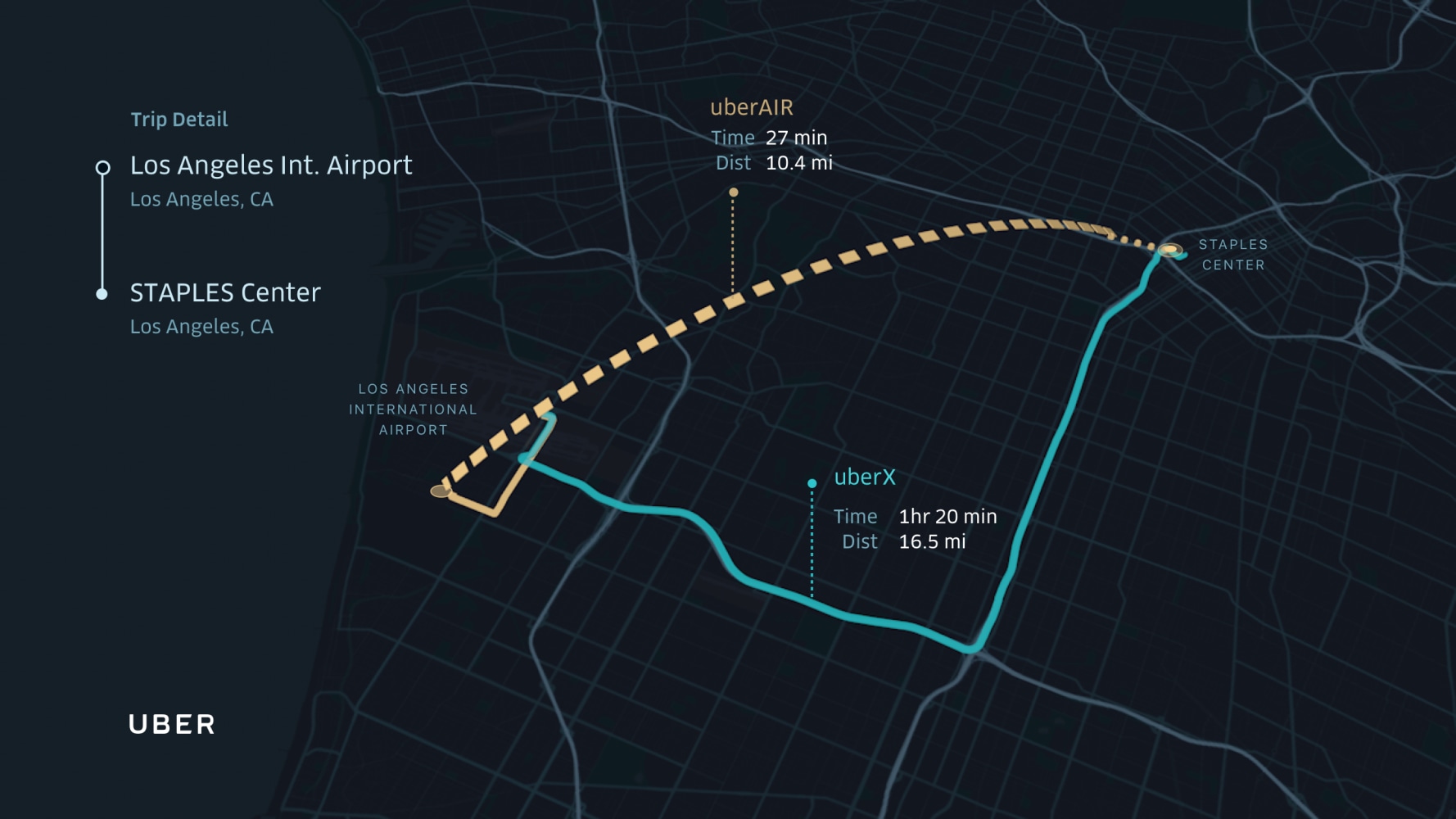
A sample trip from Los Angeles International Airport to the Staples Center in downtown Los Angeles. Courtesy Uber
While the ride-hailing service and the U.S. space agency may seem like an odd couple, the relationship is necessary in order to keep everything running smoothly when Uber ultimately takes to the skies.
"The space act that we signed with NASA is initially about collaboration around air traffic management," Jeff Holden, Uber's chief product officer, told NBC News. With so many aerial vehicles flying at a low attitude, the collaboration will be necessary to help manage the skies.
Related: Uber's Fleet of Flying Taxi Cabs
Uber also announced that Los Angeles will be the second U.S. city where it will test its uberAIR service. Dallas-Fort Worth is the first U.S. launch partner, while Dubai will be the first global city.
Holden said he expects Uber will have its first flight demonstrations in 2020 and have the service commercially available by 2023. That's well ahead of the 2028 Olympics in Los Angeles, where the service could be especially useful as an already congested city prepares to host athletes and fans from around the world.
Uber's air travel initiative was announced last October with the promise of putting an end to long commutes, letting passengers hail an aircraft ride with the push of a button. In the case of Los Angeles, Uber has 20 strategically placed locations around the city for the Uber network.
In a video released Wednesday by Uber, the company showed what it will be like to order a seat on one of the aircraft, which will take off and land vertically.
"It’s an inspirational way to travel, too," said Holden. "You push a button, fly over the city, and you land. No volatility."
If everything goes according to plan, it will also be economical. A commute between San Francisco and San Jose, which would typically take two hours during rush hour and cost $111, would be cut down to just 15 minutes.
That route by air could initially cost $129, with the price dropping to $43 in the near term and $20 in the long term, according to a forecast from Uber.
Holden said he's confident Uber can stick to the timeline. And when people finally get to commute by air, he hopes they think of it as an "incredibly life-changing experience."
"This offers people the opportunity to get from point A to point B super fast," he said.
Not only that, but he hopes the price will delight passengers, too. "[I hope people say], 'I can not believe how inexpensive this is. I can afford to use this type of service every day."
Related: Elon Musk Reveals First Photo of Tunnel Under LA to Bypass Traffic
While Uber is going high, Elon Musk is going low.
The Boring Company, which began as an idea Musk shared on Twitter, is making real progress on its first tunnel. Last month, the Tesla and SpaceX CEO showed off the first photo of a tunnel being dug in the Los Angeles area.
"Should be 2 miles long in three or four months and hopefully stretch the whole 405 [north to south] corridor from [Los Angeles International Airport] to the 101 in a year or so," Musk tweeted.
The way Musk sees it, cars and people would be able to travel through the Boring Company's network of tunnels on an electric sled. Those sleds would pick them up at designated spots above ground along the tunnel network. The cars would then be taken in an elevator down to the tunnel, where the sleds could reach speeds as high as 150 mph, getting people where they need to be faster and making rush hour traffic a relic of the past.


