Unrealism: the Key to Realism

thrasherpix

Scooby
Joined
Mar 13, 2016
Messages
5,314
Age
43
This is a vid I saw not too long ago and I was reminded of it over another thread I saw on BB earlier today. I know more than once the "reality" of Buffy at times gets debated, and I sometimes have to overlook a lot.

But anyway, there is this commentary on how it's good not to be TOO real even when you're trying for a certain level of reality, because the closer you get to it, the easier it is to break the immersion as little things invariably shatter it. It can also create the Uncanny Valley effect in a more broad sense in that being "just slightly off" can be more disturbing than being way off.


It starts off with high school dramas, and how his view of them changed as he became a high schooler...at least for his generation. High school drama of previous generations were still okay for him. He then goes on to other ways in how this plays out, like how the difference between veterans of the Vietnam War and non-veterans saw the first and second half of Full Metal Jacket as just one example.

Though if you just want the gist of it, then click to 3:15 and read the screen (or listen from the 3 minute mark up to 3:15).

Just thought it was some interesting observations so I'm sharing for anyone else who might be interested.
 
I quite enjoyed that video, thanks for posting 🙂 makes sense and is something that will drift back to mind later tonight. Like stimulating the thought process. Love it.
 
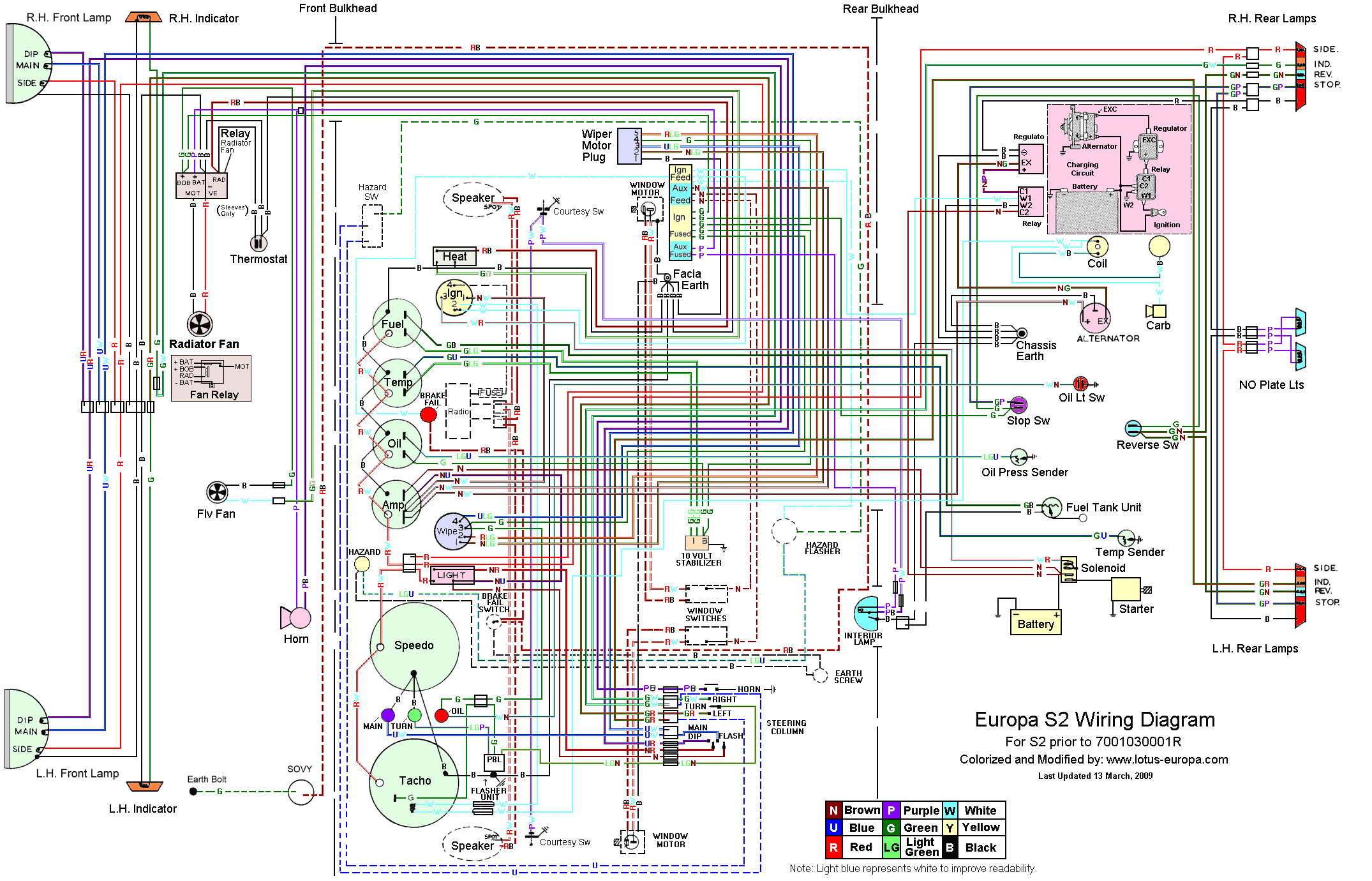
Bear with me, this explanation comes from electrical engineering rather than arts appreciation and it takes some explanation. I see the viewer in electrical terms as being a viewer of either a wiring diagram or a schematic. A wiring diagram shows the placement of parts as you would see them in a unit. A schematic is a further level of abstraction that shows the logical flow of a circuit without regard to what it looks like physically. Similarly, in a movie, if you expect to see things as you would see them in real life, then you are oriented to a wiring diagram. If while you are viewing the movie, you are distilling the essence of the concepts that are being presented, you are more oriented to a schematic.

I have not been able to find a wiring diagram and a schematic for the same item, but this may suffice for the sake of explanation:

s2-diagc.gif


The diagram above is a wiring diagram for a Lotus Europa. The diagram shows the placement of items on the drawing as they appear in the car as if you are looking at it from the top with the front of the car at the left. This is a mid-engine car so engine details are at the right. The wire colours in the wiring harnesses on the car are as presented on the wiring diagram as coloured lines. No thought is required to read this diagram once you get the hang of it. Just look at the placement and make the connections.

The following is a schematic to a radio but although it is an Emerson, the same design, known as the All-American Five was a five-tube radio made from the late 1930's to about 1970 by almost every manufacturer in business during that era:

emerson-model-501-schematic-parts-list-radio-news-november-1947-1.jpg


Nothing on the diagram resembles the physical layout of the parts. The items in the five circles are tubes. The lines are connections. The zigzag lines are resistors. The devices shown as one straight plate and one curved plate in a line are capacitors. The two capacitors with an arrow through them are the sections of the tuning capacitor. The six capacitors with an arrowhead on the curved line are trimmer capacitors. L1 on the left is the loop antenna. The other curled lines are inductors or transformers of various descriptions. SP1 on the right is the speaker. The design follows a linear signal flow from left to right at the top and the power section is on the bottom including PL1, the plug for the line cord. This is a logical rather than physical depiction of the design. There is no indication of the size of the parts. This is a further level of abstraction from the wiring diagram. If you are schematically oriented, you are looking for the underlying concepts rather than the physical appearance in a movie.

Which realism do you prefer? The wiring diagram shows you what you see which is the equivalent of seeing the person in the movie as not just a character but also how (s)he is dressed, what era the styles represent, what technology is in use and a lot of other surface characteristics. The schematic is the equivalent of seeing what part the person plays in relation to other parts regardless of appearance or physical characteristics. You have to be able to understand the people from a superficial standpoint which varies with the era of the movie. But you also have to see the underlying truths and if this is more important, then the physical characteristics are of less consequence.
 
Back
Top Bottom