
You are using an out of date browser. It may not display this or other websites correctly.
You should upgrade or use an alternative browser.
You should upgrade or use an alternative browser.
Whipping in horse races
- Thread starter ILLYRIAN
- Start date

brinkster130
Riley's BFF

Skanky Vamp
Sniffin' the Slayer
- Joined
- Aug 12, 2008
- Messages
- 26,460
Have you seen Luck? The show itself touched on a little, but the background stuff really brought it to alot of peoples attention.It's one of the less concerning aspects of the sport.

GwenRaiden
AKA Apology Girl
Sorry, but horse racing absolutely disgusts me. Horses dying in the name of entertainment and gambling is despicable. They race horses from when they are young and their bones are underdeveloped and more susceptible to injury, mostly always fatal. They give the horses drugs to mask pain when instead they should be resting or getting treatment. I heard that a sports commentator for the grand national referred to dead horse on the track as an "obstacle". I mean, heartless much. Ugh, disgusting industry. Horse are lovely, beautiful, soulful creatures - the way they are treated in racing is deplorable.
brinkster130
Riley's BFF
brinkster130,
less concerning because of what?
Whipping is regulated and somewhat watched because of animal rights activists and it can be seen since it's done out in the open. What's not so regulated (or acknowledged) is the drugs (both legal and illegal) that are given to horses, harsh training conditions, breeding, number of horse deaths while on certain tracks, animals being disposable, corruption, and the fact that it's a sport all about money not the actual sport.
Have you seen Luck? The show itself touched on a little, but the background stuff really brought it to alot of peoples attention.
I haven't; but I fell down a horse racing rabbit hole after going to a few races leading up to the Kentucky Derby. It's facinating really. I'll have to check Luck out.
Skanky Vamp
Sniffin' the Slayer
- Joined
- Aug 12, 2008
- Messages
- 26,460
It's the best work that Hoffman has done in a long while.. PETA got it canceled after a season, but it's worth watching if you like it. Don't even get me started on Kentucky Derby! I could have made a boatload on Tabasco Cat a long time ago, but I didnt want to ride down there with my boss and he didnt want to bet.I haven't; but I fell down a horse racing rabbit hole after going to a few races leading up to the Kentucky Derby. It's facinating really. I'll have to check Luck out.
Also, if you've Amazon Prime, Luck is on it. It's a great show, and it helps that you fell down the hole because they talk alot about betting and if you don't understand it, you dont understand it!
Let me know if you are going to watch.. I could watch it again.

brinkster130
I do have prime. I'll probably check it out next week sometime.

ILLYRIAN
Druish Pervonian Wizard
brinkster130,
understood. So much is wrong with horse racing, but I was directing my enquiry to the use of the whip. How it affects the horse, the type of whip used, does it do what it is intended to.
understood. So much is wrong with horse racing, but I was directing my enquiry to the use of the whip. How it affects the horse, the type of whip used, does it do what it is intended to.
Skanky Vamp
Sniffin' the Slayer
- Joined
- Aug 12, 2008
- Messages
- 26,460
I'm not brinkster, but I can answer. A lot depends on the horse. Some respond well and some don't. Some horses you just wave the whip and don't even have to use it on the horse itself and it works. The whip does more than just 'encourage' the horse to run faster, its also for lane changing and racing 'tactics'does it do what it is intended to.
ILLYRIAN
Druish Pervonian Wizard
Okay Mr. Pole,
If you really want me to reply to you, about reply #9. How can a horse respond well to a whip? It is used to promote a reaction. If a person prods a horse in the neck that is annoying to the horse the horse will move backwards. So if the whip causes the horse to move forward after the first use of the whip, how will the horse continue to react if use of the whip only provokes more pain?
Some horses you just wave the whip to and it will react. I fail to see how that could happen, during a race the jockey leans forward far enough to let the horse see the whip?
Using the whip to get a lane change? Jockey's tend to hold a bit of leather that is linked to a horses mouth, now if they held the bridle.. ..
I don't like any use of the whip. There are some race horses that never see a whip, the jockeys are told never to carry a whip near the horse,
there are more whip free horse races these days.
If you really want me to reply to you, about reply #9. How can a horse respond well to a whip? It is used to promote a reaction. If a person prods a horse in the neck that is annoying to the horse the horse will move backwards. So if the whip causes the horse to move forward after the first use of the whip, how will the horse continue to react if use of the whip only provokes more pain?
Some horses you just wave the whip to and it will react. I fail to see how that could happen, during a race the jockey leans forward far enough to let the horse see the whip?
Using the whip to get a lane change? Jockey's tend to hold a bit of leather that is linked to a horses mouth, now if they held the bridle.. ..
I don't like any use of the whip. There are some race horses that never see a whip, the jockeys are told never to carry a whip near the horse,
there are more whip free horse races these days.

How can a horse respond well to a whip? It is used to promote a reaction. If a person prods a horse in the neck that is annoying to the horse the horse will move backwards. So if the whip causes the horse to move forward after the first use of the whip, how will the horse continue to react if use of the whip only provokes more pain?
There are some misconception about the use of whips. I've been working in the horse industry for about 10 years (not the racing industry, I ride and train English), and riding for over 15yr, but we use the whip nonetheless. The whips are not made to hurt, in fact, in lessons we teach our students how to properly use a whip by using it on their hand, it doesn't hurt one bit, but does make a loud noise. Most often than not, in races, the whips are waved around, not actually used to hit the horse. It is used as a signal to the horse, not as a punishment. I myself have never used a whip to make a horse go faster, but a whip can be great to teach cues, or help a horse understand what you mean (for example, when teaching a horse a side pass, meaning going side ways, you use your legs, but new horses won't necessarily understand that. A dressage whip can be carried as an extension to the leg, no need to "hit" the horse, but tapping can be used as a cue). Another example is over jump, I've had to hit my horse behind the leg to ensure a good take off. This can actually prevent injuries, as a bad take off to a jump can result in a bad fall. I'm not saying whips on the racetrack should be used, but all I'm saying is that whips are not necessarily evil. In the wrong hands, yes they are. But if used as a tool, they hurt no more than a ruler used to measure stuff. It's only when the ruler is used to punish children that it becomes evil.
Like @brinkster130 said, there's lots of stuff wrong with the racing industry, whips are not a big concern. I have never in my life witness a horse got hurt from a whip. Only "bull type" whips actually hurt, the "English whip" carried during races are not meant to hurt a horse. I'd be more worried about other conditions on the race track.
That being said, it is also important to note that not everyone in the racing industry is like that, and many horses are better taken cared of than many "pet" horses. I had the chance to meet many, many racing people, and some of the horses were loved and extremely well taken cared of. I even had the chance to ride a race horse once, which was one of the best experience of my life, and those horses were just so happy to get out there. Sadly this isn't true of all race people, and there's a lot of abuse in the industry, but this is certainly not limited to the racing industry. There's likely more abuse from backward breeders (the puppy mill of the horse industry) than there is of the racing industry.
Again, I don't agree with a lot of the stuff they do, but as a horse lover that has seen the industry first hand, not all of it is evil. Some of these horses do love their job, some of these horses are well taken cared of. Just as some of these horses are drugged and over exercised. Where I am from (North Ontario), racing actually doesn't exist anymore. A decision I much agree with if it means more horses are safe and sound. Sadly, I'm not sure this is what it means, as the amount of rescue and auction horses have climbed up really quickly in the pass years (many of which end up at the meat buyer). We need to examine the industry as a whole, not just at the racing industry. Abuse, sadly, occurs much too often around horses (my own horse was bought from the auction, while being pregnant at a young age, after likely being abused).
(Sorry for the long post)

Yeah, agree with what Blaze & brink said - using a crop on the horse isn't harmful (horses kick and bite each other all the time - your little crop isn't going to damage it).
Racing a 2 year old is infinitely worse than using a crop on one.
Racing a 2 year old is infinitely worse than using a crop on one.

Sorry, but horse racing absolutely disgusts me.
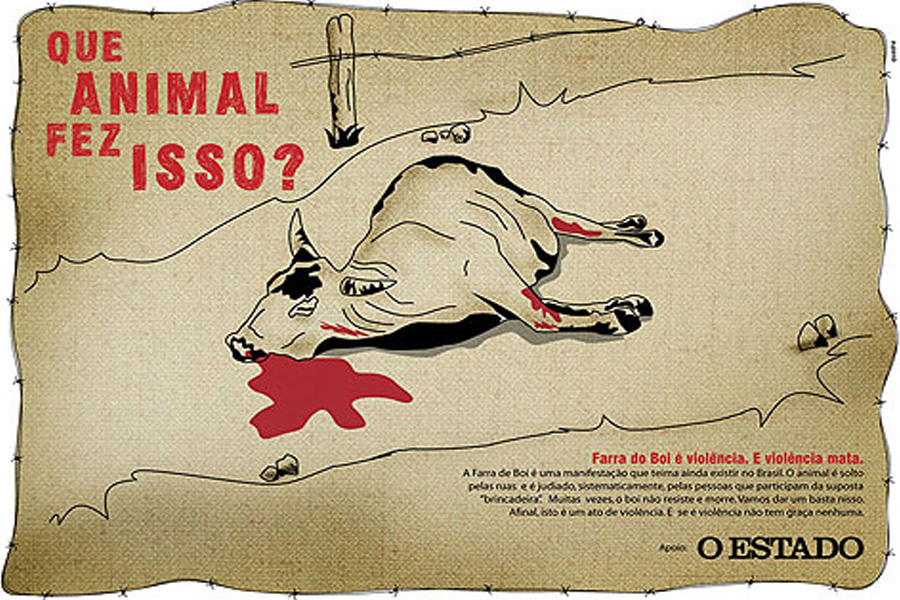
Rodeo, Portuguese-style bullfighting, running of the bulls, farra do boi, animals in circus, fox hunting, conformation/breed shows (what some people do to the dogs are just despicable).
Farra do Boi
What animal did that?
The whips are not made to hurt, in fact, in lessons we teach our students how to properly use a whip by using it on their hand, it doesn't hurt one bit, but does make a loud noise.
I really don't know anything about horse races, or horses for that matter, so I'll take your word for that.
Last edited:
Skanky Vamp
Sniffin' the Slayer
- Joined
- Aug 12, 2008
- Messages
- 26,460
They use electric prods and spurs to get the animals into an irritated state. Even before the event starts they give them hotshots to fire them up. They use a bucking strap that can cause open wounds and buck-burns (as when they buck, it rubs them raw) leading to infections that, depending on the location and quality of the rodeo, can go untreated. They routinely have ribs broken, lose massive amounts of blood and at the end of their time on the circuit are sold to a slaughterhouse.What do you dislike about rodeo? Just curious.
🙂
Or at least thats what they say... if interested you can read this it's a few years old but will give you more examples.. take it with a grain of salt though.
What do you dislike about rodeo? Just curious.
Everything. The stupidest "sport" ever.
...docile animals are physically provoked into displaying “wild” behavior in order to make the cowboys look brave. SOURCE
same same
Um deles, tem um bastão que serve, aparentemente, para espetar os bois. Outro peão também carrega um bastão metálico, de um metro, com o qual bate na cabeça dos animais que esperam para ser montados. Em um outro flagrante, um peão está sentado na área de “preparo” dos bichos com um bastão amarelo que, afirmam os ativistas, é usado para dar choques e estressar os bois para a competição. SOURCE
And no, I'm not a vegetarian, I eat animals, but the way they are treated until they reach our tables are really upsetting, in most of cases. Shame on me. 😳