Fruit in the Wild

Skanky Vamp

Sniffin' the Slayer
Joined
Aug 12, 2008
Messages
26,460
Black Thorn
Next time you bite into a slice of watermelon or a cob of corn, consider this: These familiar fruits and veggies didn't always look and taste this way.

Genetically modified foods, or GMOs, inspire strong reactions nowadays, but humans have been tweaking the genetics of our favorite produce for millennia.

While GMOs may involve splicing genes from other organisms (such as bacteria) to give plants desired traits — like resistance to pests, selective breeding is a slower process whereby farmers select and grow crops with those traits over time.

From bananas to eggplant, here are some of the foods that looked totally different before humans first started growing them for food.

Wild watermelon
wild-watermelon.jpg

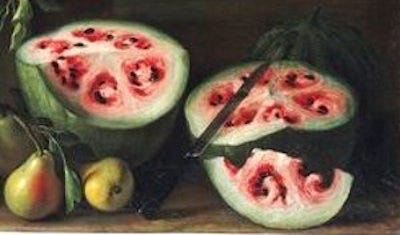
This 17th-century painting by Giovanni Stanchi depicts a watermelon that looks strikingly different from modern melons, as Vox points out. A cross-section of the one in the painting, which was made between 1645 and 1672, appears to have swirly shapes embedded in six triangular pie-shaped pieces.

Wild banana
wild-banana.jpg

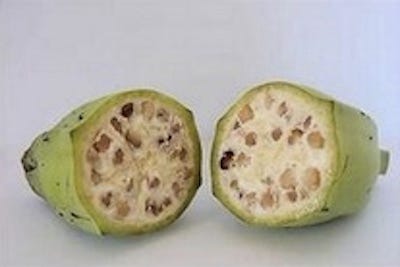
The first bananas may have been cultivated at least 7,000 years ago — and possibly as early as 10,000 years ago — in what is now Papua New Guinea. They were also grown in Southeast Asia. Modern bananas came from two wild varieties, Musa acuminata and Musa balbisiana, which had large, hard seeds, like the ones in this photo.

Wild eggplant
wild-eggplant.jpg

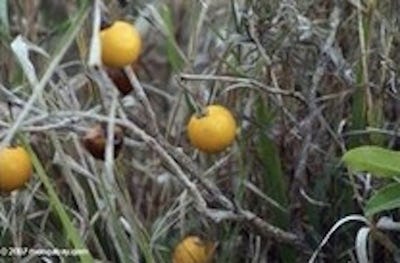
Throughout their history, eggplants have come in a wide array of shapes and colors, such as white, azure, purple, and yellow — like those shown here. Some of the earliest eggplants were cultivated in China. Primitive versions used to have spines on the place where the plant's stem connects to the flowers.

Wild carrot
wild-carrot.jpg

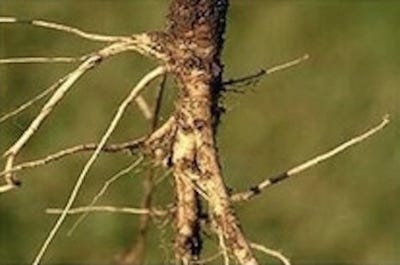
The earliest known carrots were grown in the 10th century in Persia and Asia Minor. These were thought to originally be purple or white with a thin, forked root — like those shown here — but they lost their purple pigment and became a yellow color.


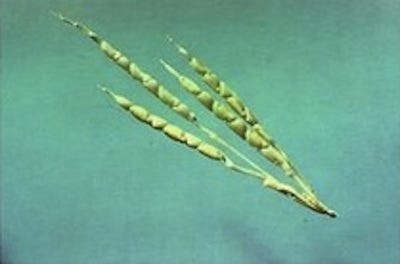
Wild corn
wild-corn.jpg

Perhaps the most iconic example of selective breeding is North American sweetcorn, which was bred from the barely edible teosinte plant. Natural corn, shown here, was first domesticated in 7,000 BC and was dry like a raw potato.
 
I'm glad carrots evolved (naturally). I put carrots in everything! Wild carrots look crap.

As a consumer, I reject GMO. I try to avoid it at all costs. Literally. Fortunately my country's (Scotland, not UK) government have the same concerns over GM crops and are formally banning the growth of GM crops here, aswell as opting out of the commercial use of GM in the EU.
 
I'm glad carrots evolved (naturally)
But that was the whole point.. they didnt evolve naturally. We made them evolve to what they are today. If they would not have been tampered with they would have remained as they were; or changed very little.
 
I wish more people saw this, it would save me the headache of explaining that we've been modifying crops for centuries.

GMO (and not just on food, but on bacteria producing drugs for example), if done right, could be highly beneficial. It's only if there is abuse (like in anything good) that the dangers arise. For example, I had a friend working to produce a GMO corn that could grow in Africa and have all the nutritional values currently missing in the poorer parts of Africa where people are dying because of nutritional deficiency. GMO crops are not needed in NA, or other developed countries, but they do have their application to save people.

And many medication, are becoming GMO based. For example they can produce human hemoglobin in pigs, for transfusion. Many vaccines are also GMO It's called Pharmaceutical Biotechnology, it's a fascinating topic.
 
Skanky Vamp
Skanky Vamp
Exactly. It has honest LIFE SAVING applications. It just depends on how it's used.
But surely you can understand why people intuitively reject GMO? I mean, aren't they trying to get rid of GMO labels for good in the US. Why do that.
 
Why are so many countries banning it?
Because it presents viable solutions to many problems we face today.. but in so doing it also changes the status quo and businesses which have been making profits off of that for some time. GMO is not the solution for everything, and it's not an overnight solution, but to vilify is looking at it with too narrow a viewpoint. The topsoil and underground water supply which feeds rivers and lakes would greatly improve from GMOs.

EDIT:
Our reliance on beef is a much bigger issue than GMOs in my opinion, but few talk about that.
 
But surely you can understand why people intuitively reject GMO? I mean, aren't they trying to get rid of GMO labels for good in the US. Why do that.

Most people that reject GMO are people that don't understand GMO. Again, as I said, there's no need for GMO food in the US, that is what is being banned. For example, GMO corn in the US is used because it has a higher tolerance to diseases and has a higher production, but it also reduces the amount of available breeds or corn because it's eradicating normal corn breeds that are less resistant. This does not only occur with GMO food, it occurs with cross bred food also, so in the cases of food, artificially selected corn and GMO corn is very similar to each other.

You have to keep in mind that most countries allow GMO to be used for medical uses. To my knowledge, Canada and the US are not the only countries studying the use of plant and animals to produce human proteins with medical uses. Transgenic animals and plants are not used on the market yet, but are in experimental testing right now. But transgenic bacteria and virus are heavily used. The vaccine for Hepatitis B is transgenic, so if you've received it, than you've taken a GMO based vaccine. The Chinese Hamster Ovary cell used in cancer research (ovarian cancer) are also transgenic, so the newest treatment for anyone who has ovarian cancer is the result of research concerning GMO.

People think GMO only concerns food, but we have to realize that GMO are now a crucial part of research, research that has already saved millions of lives.
 
GwenRaiden
GwenRaiden
Cool. I should have been more clear - I understand the medical benefits and that it doesn't just apply to food. Our country is continuing to use GM in science - I agree that there's no need for GMO food.
there's no need for GMO food in the US
But I think there is. It could enable you to grow in land not currently being either grown on or occupied. It would enable the crop to be more 'weather resistant' as well; so the 300 million dollars my state lost in crops due to too much rain could/would have been less. How many crops in Florida are lost due to slight weather fluctuations? This not only renders the time spent cultivating the crop moot, but is a huge economic hit. Having GMO crops would/could also reduce the massive amounts of pesticides that are needed to maintain commercially viable crop production.
 
Blaze
Blaze
Good points
In Europe, if a food is GMO, there must be a label that states this. In the US, no one is permitted to identify a food as GMO, leading many to suspect that this is collusion with Monsanto, the largest manufacturer of GMO seeds. Indeed, there is a revolving door between vice-presidencies at Monsanto and corresponding levels at the FDA (Food and Drug Administration) meaning that the FDA will always favour Monsanto and GMO regardless of the facts. The FDA has had some spectacular failures in the past like DES and thalidomide. They have also rubber-stamped food colouring agents even though some people have severe reactions to them (and not just children as is usually reported).

It seems sort of like nuclear power which can be handled safely but is shrouded in enough secrecy that a lot of people do not trust it and occasional disasters (many of which are not reported in the news) happen.
 
In the US, no one is permitted to identify a food as GMO
That is a large part of the problem. It's not GMO that's faulty, it the labeling of GMO. They are fearful that if food is labeled as GMO there will be a mass exodus of customers. I don't see that happening. A vast majority of the people (sadly) dont know the difference between GMO and HMO.
 
That is a large part of the problem. It's not GMO that's faulty, it the labeling of GMO. They are fearful that if food is labeled as GMO there will be a mass exodus of customers. I don't see that happening. A vast majority of the people (sadly) dont know the difference between GMO and HMO.

I think it's a little more than that. If a problem occurs, Monsanto does not want people to have evidence on which to base a lawsuit.
 
I think it's a little more than that. If a problem occurs, Monsanto does not want people to have evidence on which to base a lawsuit.
Depends on who you talk to.. I have anecdotal evidence of vendors that fear labelling for that very reason. They are afraid if people know what they are actually eating they will stop eating it.
 
The FDA has had some spectacular failures in the past like DES and thalidomide.

FDA really gets a bad rap for a few mistake (admittedly, costly ones), but the truth is the majority of FDA drugs are successful and safe. Saying that FDA doesn't hear the facts is simply not true. There are lots and lots of issues with the Big Pharma, they are very greedy I'll give you that, but when something is put on the market, it has gone through multiple clinical trials. It is as safe as it can be, but even then there are risks. Which is exactly what happened with Thalidomide, that drug is not toxic on pregnant animals, it is unique to humans, and clinical trials were not conducted on pregnant women. At the time scientists didn't know that a reaction in human could be different than the one found in chimps, dogs, rats, and other animals for which the drug was safe. Now we know better. It really is a awful mistake that caused some awful consequences, but the truth is that FDA isn't just an evil power hungry company, the research done before putting the drugs out there is done by knowledgeable scientists that for the most part want to better the world. And the system to ensure safety is extremely strict. It won't just favour GMO because of the money, it does look at the facts. And the truth is most facts point to GMO being safe, and might present a good way to solve problems like famine.
 
Back
Top Bottom